(第一段)
I
stopped to let the car cool off and to study the map.
语法分析:
I stopped to let the car cool off(目的状语) and
to study the map(目的状语).
知识点(1)
cool off v. 英文解释:to return to
a normal temperature after being hot 冷却下来,凉爽下来
Cool off with an iced drink.
By late autumn Mediterranean islands have cooled
off, and can have rainy days.
知识点(2)
study v. 英文解释:examine (sth)
very carefully 仔细察看(某事物)
I
had expected to be near my objective by now, but everything still seemed
alien to me.
知识点(1)
expect (sb.) to do 以为;料想
知识点(2)
objective n. 目 标 , 目 的
= goal
知识点(3)Lesson25
by now (增加现场感)在那个时候
= by then
知识点(4)
be alien to … 对某人来说是陌生的
a way of life that is totally
alien to us
The idea is alien to our
religion.
Luxury is alien to her nature.
I
was only five when my father had taken me abroad, and that was 18 years
ago.
When
my mother had died after a tragic accident, he did not quickly recover
from the shock and loneliness.
知识点(1)Lesson44
recover from … 从……恢复
recover sth. 含义1: 恢复……
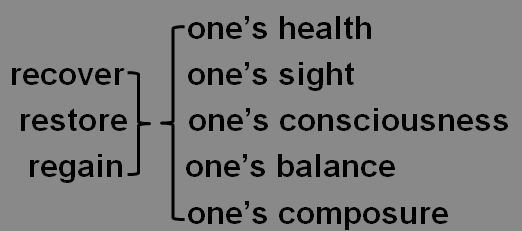
= restore sth. / regain
sth.
recover sth.
含义2:重新获得,找回,赚回,补偿
Four paintings stolen from the gallery have been
recovered.
We recovered lost time by setting out
early.
But the claim made by a local authority to
recover the cost of salvaging a sunken pie dish
must surely be unique.
Everything
around him was full of her presence, continually reopening the
wound.
知识点(1)Lesson54、55
presence n. 含义1:
出席,在场,存在
We enjoy staring at them entranced as they go about their
business, unaware (we hope) of our
presence.
At present, there is no telescope in existence that is capable of
detecting the presence of life.
in the presence of sb. 某人在长的情况下
in sb.’s presence 某人在长的情况下
Harry is very thrifty, but in the presence
of his friends he never shows this side of his
life.
I asked you not to smoke in my
presence.
presence 含义2:n. a person or
spirit that you cannot see but that you feel is with you in a place
似乎在场
知识点(2)Lesson18、54
【辨析】
continually adv. 不断地;频繁地
continuously adv. 连续不断地
These lights flickered continuously like
traffic lights which have gone mad.
Almost immediately he began to complain about the weather, for
even though it was still summer, it rained
continually and it was often bitterly
cold.
be continually / always doing
老做某事(Lesson2)
知识点(3)
reopening adj. 重新开的;重新开放的;重新开始的
So he decided to emigrate.
In
the new country he became absorbed in making a new life for the two of
us, so that he gradually ceased to grieve.
知识点(1)
make a new life for sb. 为……开创新生活
【辨析】
turn over a new leaf 弃恶从善,洗心革面重做人
知识点(2)Lesson35
cease to do / doing: stop doing
停止做某事、不再做某事
区别:
cease to do 一般表示状态
cease doing 可以是正在做的可延续的动作
That department has ceased to
exist.
The factory has ceased making
bicycles.
There are rare instances when justice almost ceases to
be an abstract concept.
【辨析】
stop doing 不再做某事
stop to do 停下手头的事去做另外一件事
Please stop smoking. Smoke really bothers
me. 停止抽烟
I’m exhausted. Let’s stop to
smoke.停下来去抽烟
Stop to smell the flowers.
知识点(3)
grieve v. 英文解释:to feel
extremely sad, especially because someone you love has died 悲伤
grieve over / for …为了某事悲伤
【同根词】Lesson53
grievance n. 委屈,不平,不满,牢骚
He
did not marry again and I was brought up without a woman's care; but I
lacked for nothing, for he was both father and mother to me.
语法分析:
He did not marry again and(并列) I was brought up
without a woman's care(介词短语做状语);
but(转折) I lacked for nothing, for he was both father and
mother to me(for... 原因状语从句).
知识点(1)Lesson23、54
bring sb. ↔︎ up 把某人抚养大
知识点(2)
lack sth. 缺乏……
lack for sth. (fml.) 需要……
= need sth.
lack for nothing 应有尽有
知识点(3)
… for he was both father and mother to
me.
语法:语义相对的名词并列,常省略冠词
Father and son went to New York by a
morning train.
We are brother and sister.
Husband and wife are talking about the
boy’s future.
Please pass me pencil and paper.
He always
meant to go back one day, but not to stay.
语法分析:
He always meant to go back(mean to do 打算) one
day, but not to stay(mean to do 打算).
知识点(1)
mean to do sth. 打算做某事
His
roots and mine had become too firmly embedded in the new land.
知识点(1)
【近义词组】表达“深深的扎根于…”:
be (firmly) embedded in …
be (firmly) rooted in …
be (firmly) entrenched in …
be (firmly) ingrained in …
But
he wanted to see the old folk again and to visit my mother's grave.
知识点(1)
folk (BrE) / folks (AmE) n. people
人们
ordinary working-class folk
I'd like a job working with old folk or
kids.
Young folk these days don't know the
meaning of work.
He
became mortally ill a few months before we had planned to go and, when
he knew that he was dying, he made me promise to go on my own.
语法分析:
He became mortally ill a few months before we had planned to
go(时间状语) and, when he knew that he was
dying(宾语从句) (when... 时间状语从句), he
made me promise to go on my own.
知识点(1)
mortally = fatally adv. 致命地
mortally / fatally +
ill(病) /
injured(伤) /
wounded(伤) 致命地…
a mortal / fatal +
illness /
injury /
wound 致命的…
【反义词】
Though Verrazano is by no means considered to be a great
explorer, his name will probably remain
immortal, for on November 21st, 1964, the
greatest bridge in the world was named after him.
知识点(2)Lesson22
alone / on one’s own
/ by oneself 独自地(没有其他人陪伴或帮忙)
She was sitting alone on a park
bench.
I don’t like walking home on my own at
night.
Do you share the apartment or do you live by
yourself?
all (alone / on one’s own /
by oneself ) 加强语气
(第二段)
I
hired a car the day after landing and bought a comprehensive book of
maps, which I found most helpful on the cross-country journey, but which
I did not think I should need on the last stage.
语法分析:
I hired a car the day after landing(时间状语)
and bought a comprehensive book of maps, which I found most
helpful on the cross-country journey(which...定语从句),
but(定语从句并列) which I did not
think(嵌入式定语从句,which既修饰maps,有做think地宾语) I
should need on the last stage(which...定语从句).
知识点(1)Lesson24、42、48 定语从句
语法:定语从句并列
1).
【同一层次上的双重定语从句】;两个定语从句修饰同一个名词或短语,中间用并列连词
(and, or 或 but) 连接,此时关系词往往不可省去。
This book is intended for foreign students who have already
mastered the elements of English, and who now
want to use their knowledge of language to read books on their own
subjects.
The past progressive is chiefly used for past actions which
continued for some time but whose exact limits
are not known.
2).
【不在同一层次上的双重定语从句】;第一个定语从句修饰前面的名词或短语,第二个定语从句修饰“名词或短语+第一个定语从句”
两个定语从句之间没有并列连词连接。第一个定语从句的关系词(一般是关系代词作宾语)
可省略。Lesson24
3). 【嵌入式定语从句 (Embedded Attributive Clause)
】:既是先行词的后置定语,又是另一个分句结构的宾语。Lesson42、48
…, but which I did not think I should need on the
last stage.
造句:她有一个养子,这个养子据她讲是个孤儿。
She has an adopted son who she says is an
orphan.
造句:Aleko
突然得到了一只新的羊羔,这只羊羔他声称是买来的。
Aleko suddenly acquired a new lamb which he
claimed was bought.
In this part of the cave, they could hear an insistent booming
sound which they found was caused by a small waterspout
shooting down into a pool from the roof of the cave.
Turning back down the main street, we quickened our pace and made
our way rapidly towards the stream where we hoped the
boatman was waiting.
备注:嵌入式定语从句和插入语的区别;插入语去掉之后应对语法没有影响,也对句子含义也没影响
It
was not that I actually remembered anything at all. But my father had
described over and over again what we should see at every milestone
after leaving the nearest town, so that I was positive I should
recognize it as familiar territory.
语法分析:
课文写法替换:(合并)
It was not
that(不是因为) I actually remembered
anything at all, but (that)
(而是因为) my father had described over and over
again what we should see at every milestone, after leaving
the nearest town(时间状语)(what… 宾语从句), so that
(所以)I was positive(目的状语从句) (that) I should
recognize it as familiar territory(形容词补足语)
.
知识点(1)Lesson39
It is/was not that …, but (that) …
不是因为……, 而是因为……
It was not that Bruce always underestimated difficulties. He
simply had no sense of danger at all.
It was not that Bruce always
underestimated difficulties, but (that) he
simply had no sense of danger at all.
【扩展】
not that …, but that … 不是因为……, 而是因为……
知识点(2)
over and over (again) 一再地,屡次地,三番五次地
【扩展】【近义词组】表达“一再地”
again and again
time after time
time and (time) again
many times
repeatedly
知识点(3)
be positive (that) … 对……确定
Are you absolutely
positive you locked the door?
回答:
I was sure /
certain / confident /
convinced (that) … 我肯定
I had no doubt (that) … 我肯定
I bet (that) … 我肯定
知识点(4)
familiar / unfamiliar territory
熟悉/不熟悉(的领域)
Well, I had been
wrong, for I was now lost.
知识点(1)
well interj. 英文解释:used for
expressing a feeling such as doubt, surprise, or anger
哎呦(表达怀疑、惊讶或愤怒等感情)
Well, they have a lot of nerve!
Well, she could at least have phoned to
say she wasn't coming!
(第三段)
I looked at the
map and then at the milometer.
语法分析:
I looked at the (look at) map and then
at the (look at) milometer.
知识点(1)
-meter 仪器、仪表
thermometer 温度表
barometer 气压计
odometer / milometer
里程表
speedometer 速度计
I
had come ten miles since leaving the town and at this point, according
to my father, I should be looking at farms and cottages in a valley,
with the spire of the church of our village showing in the far
distance.
语法分析:
I had come ten miles since leaving the town(时间状语), and
at this point(地点状语), according
to my father(介词短语做状语), I should be looking at farms
and cottages in a valley(后置定语), with the spire
of the church of our village showing in the far
distance(独立主格).
知识点(1)
come = travel
知识点(2)Lesson6
语法: 独立主格;(with) + n. (逻辑主语)+
非谓语 (doing / done / to do, 其中 being 常省略),
在句中常作状语或定语
The silence was suddenly broken when a large car, with
its headlights (being) on and its horn
blaring, roared down the arcade.
It is possible that upon such an occasion a battle ensued,
with the sharks being driven away or
killed.
I
could see no valley, no farms, no cottages and no church spire-only a
lake.
I
decided that I must have taken a wrong turning somewhere.
知识点(1)Lesson43
decide
不一定译为“决定”,而常常译为“(在考虑之后)确定,断定,认为”,尤其是其后加
that 引导的宾语从句时。
The pie committee decided(确定,断定,认为)
that the best way to transport the dish would be by canal, so
they insured it for the trip.
From then on, Harry decided(确定,断定,认为)
that this little game he had invented might prove to be
expensive.
I decided(确定,断定,认为) that I must
have taken a wrong turning somewhere.
Her first impulse was to go round all the rooms looking for the
thieves, but then she decided(确定,断定,认为)
that at her age it might be more prudent to have someone with
her, so she went to fetch the porter from his basement.
知识点(2)
turning (BrE) / turn (AmE) n.
道路转弯处
So
I drove back to the town and began to retrace the route, taking frequent
glances at the map.
语法分析:
So(所以) I drove back to the town and began
to retrace the route, taking frequent glances at the
map(非谓语动词做伴随状语).
知识点(1)
retrace v. 含义1:to go back
exactly the way you have come 折返
retrace v. 含义2:repeat (a
journey, route, etc.) exactly 重走
知识点(2)
take / shoot / throw / cast a
glance at … 扫视……
I landed up at the same
corner.
知识点(1)
land up = end up = finish
up
英文解释:to finally be in a particular place or
situation 最终;最后……
land up / end up / finish up
doing 最终;最后
The
curious thing was that the lake was not marked on the map.
I
felt as if I had stumbled into a nightmare country, as you sometimes do
in dreams.
语法分析:
I felt as if I had stumbled(虚拟语气) into a nightmare
country, as you sometimes do in dreams(方式状语从句).
(as if... 表语从句)
知识点(1)Lesson33
语法:as if / as
though
从句中表达与事实相反或可能性很小时,可以用虚拟语气。与现在事实相反用一般过去时(be
动词一般用 were),与过去事实相反用过去完成时,与未来趋势相反用
would / should / could / might +
动词原形
It is as if a single unimportant event
set(过去式,虚拟语气,与现在事实相反)
up a chain of reactions.
As if this
were(过去式,虚拟语气,与现在事实相反)
not enough to reduce you to tears, your husband arrives, unexpectedly
bringing three guests to dinner.
I felt as if I
had
stumbled(过去完成时,虚拟语气,与过去事实相反) into a nightmare
country, as you sometimes do in dreams.
It looks as if it
might(虚拟语气,与未来趋势相反)
rain.
注意,as if / as
though从句中虚拟语气为进行时的时候,一般都用were doing
的形式。
'Oh, that,' he said with a smile as if he
were talking about an old
friend.
Suddenly, the knocking turned to a forceful banging,
as if someone were
hitting the door with a metal rod. (The Da Vinci
Code)
It looks as if he were
talking to someone invisible.
知识点(2)
stumble into … 英文解释:to become
involved in sth. by chance 偶然卷入、参与或陷入……
知识点(3)
And, as
in a nightmare, there was nobody in sight to help me.
语法分析:
And, as in a nightmare(方式状语从句), there was
nobody in sight to help me.
知识点(1)
语法: 连词as
引导的方式状语从句中常省略主句中出现过的成分而只残存“as+状语”结构。
And, as in a nightmare, there was nobody in sight to help
me.
And, as there is nobody in sight to help me in a
nightmare, there was nobody in sight to help me.
考研阅读:
In New York, as in some other cities, environmental
pollution is becoming more and more serious.
In New York, as environmental pollution is becoming more and
more serious in some other cities, environmental pollution is
becoming more and more serious.
Fortunately
for me, as I was wondering what to do next, there appeared on the
horizon a man on horseback, riding in my direction.
语法分析:
Fortunately for me(状语), as I was wondering what to do
next(宾语从句)(时间状语从句), there
appeared(全部倒装) on the horizon a man on horseback,
riding in my direction.
知识点(1)Lesson10、17、56
语法:全部倒装(把全部谓语置于主语之前。)
这种倒装主要目的是为了突出句末的主语。
Now comes your turn.
On the hill stands a
temple.
In came Miss Green.
There are two people.
There once stood a little
village.
Next came a horse, …
课文:
…, there appeared on the horizon a man on horseback,
…
正常语序:
…, a man on horseback appeared there on the horizon,
…
不能倒装
Off he went. 主语不能是代词
On the hill John saw Mary. 谓语是及物动词
表语置于句首。这种倒装主要目的是为了避免头重脚轻(主语较长)。
Happy is he who has a sound mind in
a sound body.
Gone are the days when my heart was
young and gay.
知识点(2)
on horseback 【idiom】骑着马;驾驭着马
知识点(3)
in sb.'s direction 朝某人的方向
I
waited till he came near, then I asked him the way to our old
village.
知识点(1)
ask / tell / show sb. the way to …
问路/指路/指路
He asked me the way to London.
Could you tell me the way to the
station?
Could you please show me the way to the
temple?
He said that there was
now no village.
I
thought he must have misunderstood me, so I repeated its name.
This time he pointed to the
lake.
The
village no longer existed because it had been submerged, and all the
valley too.
The
lake was not a natural one, but a man-made reservoir.